

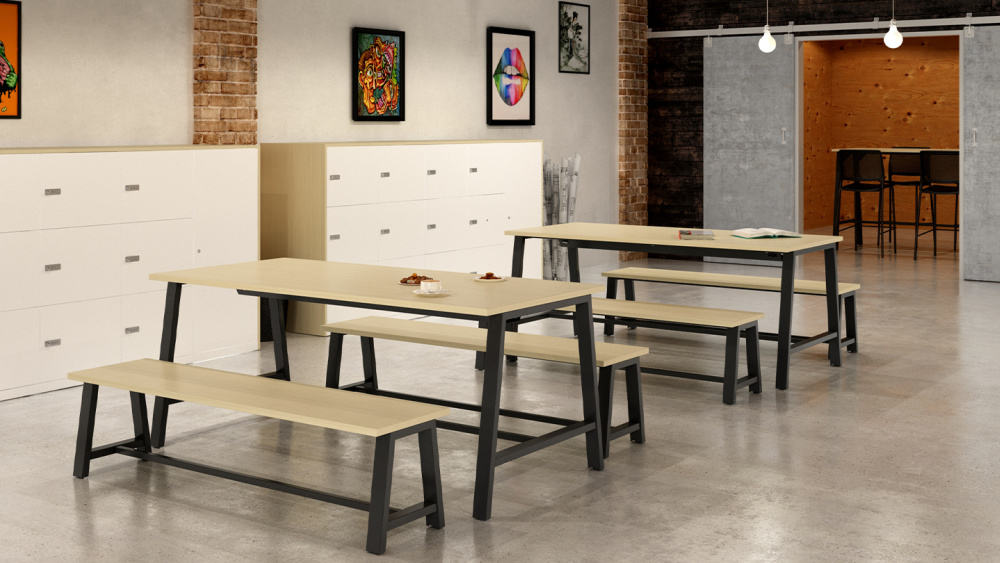
For a wide range of venues and buildings, it’s important to be able to maximise the number of people that can be accommodated. From hospitality venues to offices, you need to know how many people can be safely and comfortably seated at your tables. If you want to know how to choose the right size table for your venue or building, then keep reading…
Why does table size matter?
Is it really necessary to give thought and consideration to the size of tables that you’re buying for your venue?
Here at Rosehill, our answer is an emphatic ‘yes’!
Table size matters, for a number of reasons:
Profitability
If you’re running a commercial space such as a hospitality venue, then the number of people you can sit at your tables (e.g. the number of ‘covers’), will have a direct, tangible impact upon your bottom line.
The more people you can seat, the more money you’ll be able to make. However, there are some practical limitations to this, which brings us to our next point…
Comfort
Being able to select the correct size tables for your venue or building will allow you to accommodate your visitors/guests/staff/patients in comfort.
You don’t want a situation where people are having to sit too close together. This is especially true in contexts where people will be dining e.g. hospitality or wedding venues.
Safety
Selecting the correct size tables for your building or venue also has safety implications.
You want to ensure that your visitors are able to easily access your tables, being able to safely sit down and get up from them. Table sizes and dimensions can have a big impact upon this.
Likewise, you will also need to think about how your tables fit within the room in which they’ll be placed. You need to ensure you select tables of such a size that allows easy movement between them.
Understanding table sizing
Okay, so by now, you’ve probably grasped why we consider table sizing to be so important.
But, what exactly do you need to know when it comes to sizing? For us, the following factors are key:
- Table shape.
- Table height.
- Length and width of the table-top (or in the case of round table-tops, diameter).
By understanding these three factors, you’ll be able to select the perfect sized table for your needs.
Let’s take a look at each factor in turn…
Table shape
Table shape is more important than simply what ‘looks nice’. For us here at Rosehill, certain table shapes lend themselves to particular uses/settings.
For example, small square tables are perfect for creating intimate dining occasions. Round tables are ideal for creating a ‘communal’ feel e.g. for meetings or cabaret-style events.
However, in both of these prior examples, if you scale those tables up too much, then the intimate or communal feel will naturally diminish.
Table shape also has an impact in terms of layout. What do we mean by this?
Well, with square and rectangular tables, you can generally push them up against each other to create larger table layouts. Circular tables don’t allow you to do this.
Then we have custom shapes like trapezoidal tables, wedges or quadrants, which can complete a configuration too – which is especially pertinent for meeting or conference rooms.
As you can see, table shape can have a big impact on the usability of your space.
Table height
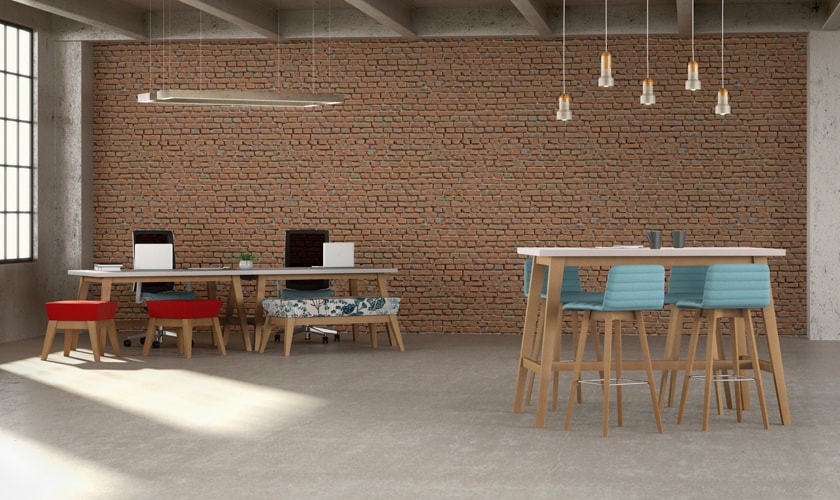
Without going into too much detail, tables tend to be available in four different heights:
- Coffee.
- Standard (also known as dining).
- Counter.
- Poseur.
Note – counter height tables aren’t as common as the others listed above, however for the sake of completion we have included them on this list. Also ‘standard’ is based here on adult-use, but would vary in education settings where you have different age groups.
Coffee table height
This one is fairly self-explanatory! Coffee tables are those low, generally compact tables that are designed to be used by people who are sitting on sofas, lounge chairs and other types of chairs that are closer to the floor.
Whilst the height of coffee tables varies from brand to brand, you’ll find they are usually between 16 and 18 inches in height (406.4 mm to 457.2 mm). However, like other types of table, it’s entirely possible to buy coffee tables that are much shorter or taller than this.
Standard table height
Standard tables (such as dining tables) are generally around 30 inches in height (762 mm). Although, having said that, you’ll find that items like desks average around 725 mm in height.
At this height, standard tables are able to be comfortably used with a wide range of dining chairs (which tend to be around 18 inches (457 mm) high).
As some tables are sold in two parts, the base and the top, you may find variations in this with different top thicknesses and adjustments to the base/feet of a table.
Counter table height
Think of counter tables as being like standard tables, but slightly ‘elevated’.
As their name suggests, they are designed to match the height of any kitchen counters or bars you may have in your premises. Because of this, you’ll typically find counter tables in bars and other similar hospitality settings.
Poseur table height
The fourth most common table height you’ll encounter is ‘poseur’. Poseur tables are 40 inches (1,016 mm) high. Sometimes poseur tables are referred to as ‘bar’ height tables.
At this height, poseur tables are designed to be used by people when they are either standing, or sitting on barstools.
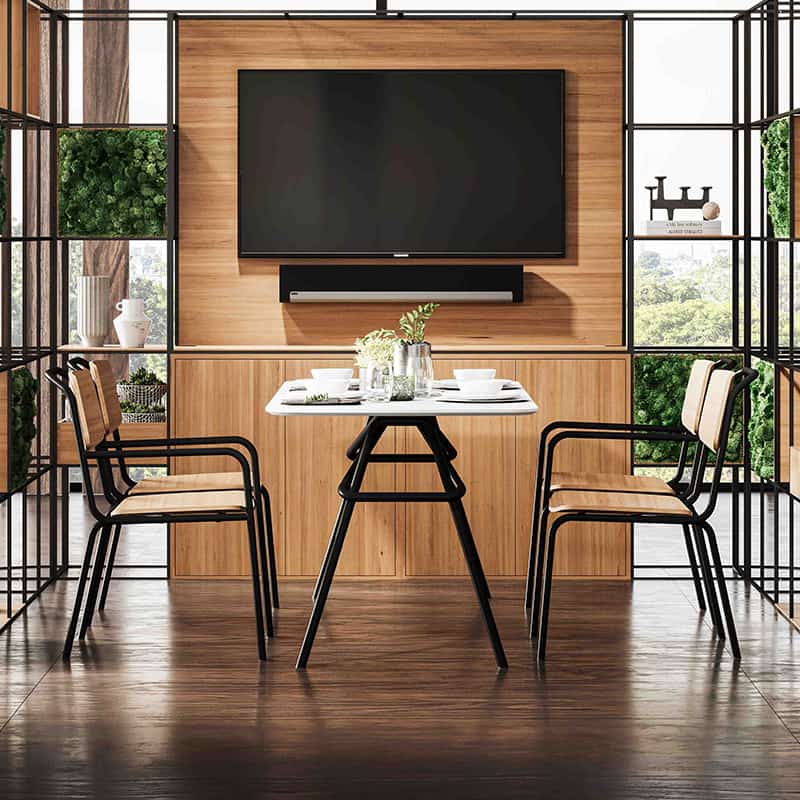
Table length and width
The third key part of understanding table sizing is the length and width (or diameter) of the table-top.
As with other items of furniture in the contract industry, table length and width is fairly standardised (we say ‘fairly’ as you will find that the available length and widths differ from brand to brand).
Below, we’ve set out each common table shape, and the lengths and widths that are available.
Fun fact – these days the contract furniture industry displays the sizing of most furniture in millimetres (mm). However, you will tend to find table sizes displayed in imperial measurements (e.g. feet and inches). This is because many customers continue to use imperial measurements.
Square tables
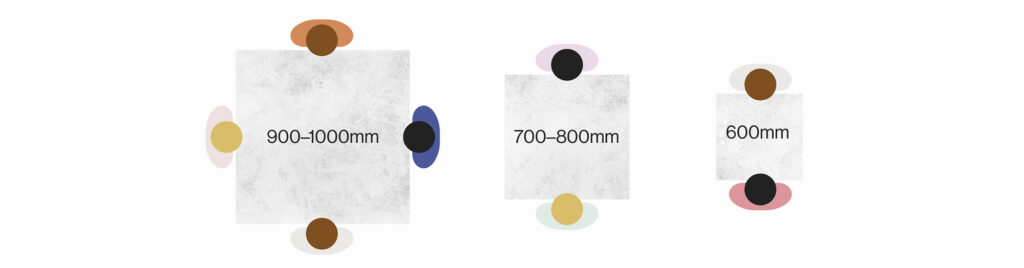
Shop around for square tables, and you’ll find that there are three common sizes available:
- 600 mm. This is the smallest size square table you’ll normally find. At this size, the table will be able to accommodate two people, but with table space only for drinks or snacks.
- 700 to 800 mm. These are the next sizes up, representing a two-seater square table that can accommodate two people, with room for plates, utensils and condiments etc.
- 900 to 1,000 mm. At these sizes, a square table can comfortably accommodate four people.
Note – the above are the average size square tables you’ll find on the market. It is possible to buy larger and/or custom size square tables. The top surface is important, when you think about the most common usage you have and how much space each user needs.
Rectangular tables
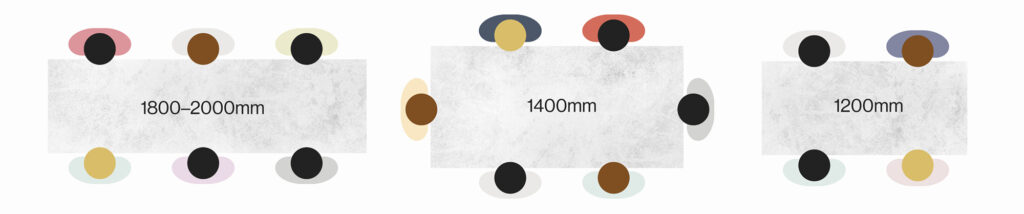
Like square tables, once you start shopping around you’ll find that rectangular tables are available in a number of distinct lengths. Width doesn’t vary hugely, so below, you’ll find the most common lengths to look out for:
- 1,200 mm. Rectangular tables of this length can accommodate four people (two on each side), but they aren’t exactly awash with space. So, if you want rectangular tables for a dining room, you may want to ‘size up’.
- 1,400 – 1,600 mm. This is the next size up and will either accommodate four people, with plenty of room for plates, drinks, utensils, or six people sat in closer proximity.
- 1,800 x 2,000 mm. These are typically the largest sized rectangular tables you’ll find available from contract furniture suppliers. At this size, you’ll be able to comfortably seat six people (three on each side of the table).
Note – if you are ordering rectangular boardroom tables, it’s possible to order them in custom sizes. In fact, it’s possible to buy boardroom tables in very large sizes which are installed and finished on-site.
Circular tables
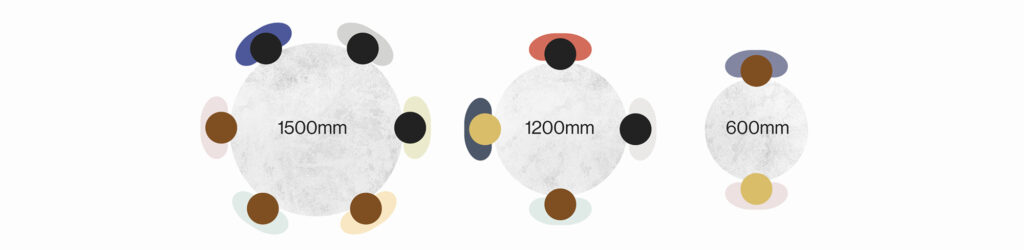
Where tables have a circular table-top, you’ll find that they are available in a wide range of diameters.
The diameter of the table-top is also often directly correlated with the type of table.
So, for example, poseur tables generally have smaller diameter table-tops, as they are only designed to hold drinks and/or small bar snacks. On average, a poseur table will have a table-top that’s approximately 600 mm in diameter.
When it comes to larger tables with circular table-tops, you’ll find that they are usually available in the following sizes:
- 4ft diameter (1200 – 1220 mm).
- 5ft diameter (1500 – 1530 mm).
Whilst the above sizes are those most commonly found in hospitality settings such as restaurants, cafes and bars, you’ll find that in settings such as weddings venues larger diameter 6ft tables are used to seat 10-12 people per table.
Table seating capacity
So far, we’ve looked at important table factors such as a table’s shape, height, length and width.
However, we realise that some of this information can seem a bit abstract when read without any context. To make it easier for you to choose the correct size table for your needs, we’ve provided a handy guide below.
What size table do I need for two people?
If you need to provide a table for two people, then you have the following options:
- A square table with a 600 x 600 mm table-top. Choose this size if the table is only to be used for drinks/snacks or coffee.
- A square table with a 700 mm or 800 mm table-top. This size is ideal if the table is going to be used for full dining.
What size table do I need for three people?
For three people, the following table option will be suitable:
- A square table with a 900 mm or 1,000 mm table-top. At this size the table will accommodate three people with space for dining utensils.
What size table do I need for four people?
With four people to accommodate, you’ll find that the following table sizes work best:
- A square table with a 900 mm or 1,000 mm table-top. This provides enough space for four people to sit and dine.
- A rectangular table with a 1,200 mm long table-top. You’ll get four people on this table, but full dining may be slightly restrictive depending on the table width.
- A rectangular table with a 1,400 mm long table-top. This will comfortably accommodate four people with full dining.
What size table do I need for five people?
When it comes to accommodating five people, you’ll need tables of the following sizes:
- A rectangular table with a 1,400 mm long table-top. This will provide plenty of space for five people to sit down and spread out a little.
- A round table that has a table-top with a diameter of 1,220 mm. This size table will provide a significant amount of space for five people.
What size table do I need for six people?
To seat six people, you’ll need a table that is one of the following sizes:
- A rectangular table with a table-top that is either 1,800 or 2,000 mm long. This will allow three people to sit on either side of the table.
- A circular table with a table-top that’s 1,220 mm (4ft) in diameter.
What size table do I need for seven or more people?
Once you reach the point of needing to sit seven or more people at a table, you’ll either need to sit them at a circular table that has a diameter of 1,530 mm (5ft) or start pushing rectangular and/or square tables together to create longer table layouts.
Other table size buying considerations
There are a few other things to think about when it comes to buying the right size tables for your building or venue.
Mix of table capacities
This point is particularly important for hospitality venues such as restaurants and cafés (but it does apply to other settings too).
Depending on your business, the footfall you receive, the mix of customers/groups you entertain, you are going to want a mix of table capacities.
This isn’t the easiest thing to figure out, but give some thought to the type of experience you provide. If you are a drinks-led establishment you’re going to want more poseur tables and smaller tables. If you are more of a dining-led establishment, then you’ll want a mix of smaller square tables and larger rectangular tables to cater for different sizes of groups.
Room layout
Will you need to push tables up against walls? In that case, you’re going to want at least some square and rectangular tables that can be pushed up close against walls (or each other for that matter).
Access
Do you have waiting staff? Then give some thought to how your tables will be laid out, and the amount of walking room/access there is between each one.
This may influence the size, shape and overall number of tables that you decide to buy for your building.
Rosehill: tables of all sizes available now
We hope you’ve found our guide to buying the right size tables for your venue or building useful.
If you’re looking for new tables, then Rosehill can help. For over 40 years, we’ve been helping businesses of all sizes to select the right tables for their needs.
With relationships with all the major contract and commercial furniture manufacturers, Rosehill is able to secure bulk buying deals and discounts you simply won’t get anywhere else.
To speak to our friendly expert team call 0161 485 1717 or email: sales@rosehill.co.uk.
Shop Rosehill’s table range now
For more commercial and contract furniture buying guides, advice and information, read the Rosehill blog…
Restaurant Furniture Buying Guide | Commercial Outdoor Furniture Buying Guide | What Is Contract Furniture?