

Spend even a small amount of time looking for items of contract furniture, and you’ll almost inevitably encounter the word ‘ergonomics’. Chairs in particular are often described as being ‘ergonomic’. But, what exactly does this term mean? Find out in this guide from the Rosehill team…
Ergonomics definition
Reach for the nearest dictionary, and you’ll find ergonomics defined as a scientific discipline that is focused on studying the interactions between people and the other elements of a system.
Sometimes also known as human factors engineering (HFE) the word ‘ergonomics’ is derived from the Greek words ergon meaning work and nomos meaning natural law.
As ergonomics refers to the interaction between people ‘and the other elements of a system’, it’s understandably a very broad field of study – after all, think of how many possible systems there are in the world.
In order to make ergonomics a more manageable field of study, it has been broken down into a number of sub-fields. These are:
- Physical ergonomics – the study of how the human body interacts with physical items e.g. tools, items of furniture, equipment. Physical ergonomics aims to ensure these interactions are as natural as possible, minimising the chance of physical harm to the human body when it is interacting with a physical item.
- Cognitive ergonomics – this refers to the study of how systems and processes can be optimised to make them easier to understand, remember and interpret by people.
- Organisational ergonomics – this is the study of how people relate on an organisational level and studies how these relations can be improved via changes to communication, processes, and hierarchical relations.
For the purposes of this article, we’ll be focusing upon physical ergonomics – as it’s this field of ergonomics that directly relates to contract furniture.
A (very) brief history of ergonomics
Ergonomics may sound like a modern discipline – however, ergonomics goes back to the very dawn of humanity. As soon as the very first member of the human family, Homo hablis, began to create hand tools (2.6 million years ago), the field of ergonomics was effectively born.
Think of it this way – the urge to create ergonomic items (be they tools or furniture) is almost innate. If you’ve ever modified something to make it more comfortable to use, then you yourself have engaged in ergonomics!
Another example of ergonomics in history is Hippocrates’ description on how a surgeon’s workspace should be set out for maximum safety and efficiency.
Fast-forward to the twentieth century, and we arrive at the point where ergonomics becomes a formalised discipline and dedicated field of study. 1952 saw the formation of The Ergonomic Society in the UK, with the U.S. following suit shortly after in 1957 with the creation of The Human Factors Society.
Today, ergonomics is a firmly established discipline with companies of all sorts employing ‘ergonomics engineers’ and ‘human factors engineers’.
Where is ergonomics applied?
Given the truly vast number of different physical items and surfaces we interact with every day, it probably comes as no surprise that ergonomic knowledge and best practices are applied in multiple industries.
To think of it another way, if you are a designer or manufacturer of near-enough anything then you are likely to use ergonomic principles in its design and manufacture.
Some of the industries in which ergonomics is most commonly applied, include:
- Automotive.
- Construction.
- Furniture design and manufacture.
- Healthcare.
- Telecommunications.
- Electronics.
If you’ve sat in a car recently, sat at a desk, used a power tool, typed on a keyboard, picked up a phone – or any one of a billion other activities – then you’ve probably benefited from ergonomics.
Ergonomics is everywhere.
Ergonomics in the workplace
One of the most common applications of ergonomics is in the workplace – specifically, office environments.
With Western economies largely shifting to ‘knowledge-based’ work, a large proportion of the workforce is employed in office jobs. For example, here in the UK, around 25% of all workers have ‘professional’ office jobs.
Office workers typically spend around two-thirds of their working day sitting at a desk working on a computer. In the past, this would result in many office workers suffering from back and neck pain, headaches, shoulder and arm pain and even injuries such as RSI (repetitive strain injury).
This quickly led to the application of ergonomic principles to office furniture. Whilst the first office chair was invented in 1849 – which took the form of the ‘Centripetal Spring Armchair’ created by Thomas E. Warren – it wasn’t until the 1970s that truly ergonomic office furniture began to appear.
The 1970s saw a number of developments that actively spurred the application of ergonomics to office furniture and design.
Firstly, the American surgeon George Phalen was the first person to draw major public attention to carpal tunnel syndrome. This raised public awareness of the injuries that can be sustained whilst working in an office.
Secondly, the introduction of the Health and Safety at Work etc. Act 1974 in the UK, and the introduction of the Occupational Safety and Health Administration Act (OSHA) in 1970 in the U.S. made employers responsible for providing a safe working environment.
As a result, employers were quick to seek out office furniture that applied ergonomic principles to reduce the chance of injury to the user.
So, you’ll find that the majority of modern offices now feature ergonomic furniture (even if it’s just the humble office chair).
However, that’s not the end of the story…
The working from home revolution
The unprecedented lockdowns and stay-at-home orders that were rolled out in response to the COVID-19 pandemic of 2020 saw people gain a new appreciation for ergonomic furniture (whether they realised it or not).
With vast swathes of workers having to work from home, people who had previously taken their ergonomic office chairs for granted suddenly found themselves perched on uncomfortable kitchen chairs, slumped in sofas, sitting in odd corners and nooks etc etc.
Faced with the prospect of having to work from home for a year or longer, people started to look for more comfortable alternatives.
It’s for that reason that searches for things like ‘ergonomic chair’ skyrocketed from early 2020 onwards:
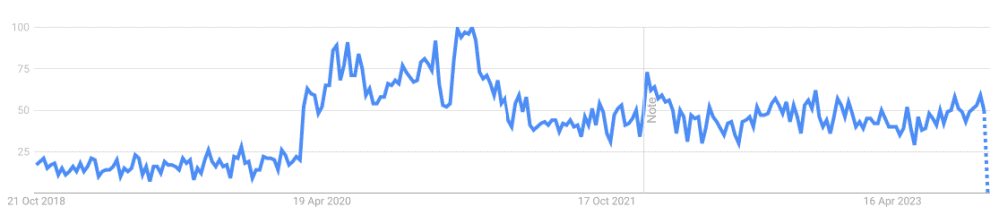
As the Google Trends data above illustrates, as working from home has become a more regular part of working life, searches for ergonomic furniture have remained higher than their pre-pandemic level.
2020 saw ergonomic furniture spread from the office to the home…
What is ergonomic furniture?
Forgive us for answering what may seem like a question with an obvious answer, but what exactly is ergonomic furniture?
Put simply, ergonomic furniture refers to items of furniture to which ergonomic principles have been applied.
As such, ergonomic furniture typically encompasses those items with which people directly interact all day e.g. seating.
Items of ergonomic furniture tend to be fairly easy to identify as they feature natural curves and features that support the human body in a natural and forgiving fashion. Furthermore, they will have been designed by someone with training in, or an understanding of, ergonomics and human factors engineering.
What types of ergonomic furniture are there?
As you’ve probably already gathered, the most common item of furniture which has ergonomic principles applied is the office chair.
After all, it’s likely that this is the item of furniture that’ll see the most ‘interaction’ with someone throughout the course of the working day.
However, there are other items of furniture to which ergonomic principles are often applied. These include:
- Desks – desks such as sit-stand desks provide additional adjustment and movement in order to better accommodate users.
- Stools – these include ‘wobble stools’ and ‘active stools’ that encourage core body strength in addition to ergonomic comfort.
- Saddle chairs – commonly used by dentists, saddle chairs have begun to make their way into office and domestic environments as they allow a high degree of movement whilst seated.
- Kneeling chairs – these are ‘backless’ chairs which are designed to distribute the body’s weight more evenly and prevent lower back pain.
- Ergonomic accessories – there are a host of ergonomic accessories that are designed to be used with other items to improve their comfort. These include monitor arms, keyboard trays, footrests, document holders and more.
What to look for in an ergonomic chair
Whether you’re buying for the office or for home, there are a number of important things to look for when buying ergonomic furniture. As ergonomic chairs are the most common form of ergonomic furniture, our buying tips below refer to this type of furniture specifically.
Understand how the body moves
In order to select the very best ergonomic furniture, you should first fully understand how the body moves as well as its key pressure points.
Firstly, bear in mind that the human body moves along three distinct planes. These are as follows:
- Frontal plane – this refers to the side-to-side movements you can make. This plane is sometimes called the coronal plane.
- Sagittal plane – referring to the right and left halves of your body, the sagittal plane covers forward and backward movements.
- Transverse plane – this plane refers to the top and bottom halves of your body and covers twisting movements.
In addition to knowing the ways in which your body moves, it’s also important to understand which parts of your body require ergonomic support.
The parts of the body that benefit from ergonomic support are:
- Lower back – arguably the most important part of the body that requires support, a good ergonomic chair will provide lumbar support. But, what does this mean exactly? Put simply, a chair with lumbar support will allow the body to maintain the natural ‘S’ shape of the spine (as opposed to forcing the spine to sit at an uncomfortable angle). This posture is known as the ‘lordotic’ posture which is agreed to be the best posture for the lower back.
- Upper torso and neck – the best ergonomic chairs will include headrests that provide support to the upper torso and neck.
- Arms and shoulders – if you’re going to be working for long periods (e.g. typing on a keyboard), then a good ergonomic chair will support the arms and shoulders via armrests.
- Hips and legs – in order to properly support the body’s hips and legs, an ergonomic chair will need to be sufficiently height adjustable and with an appropriately sized seat pan for the user.
Understand the above points, and you’ll be in a position to make an informed decision regarding a new ergonomic chair.
Seat fit
First and foremost, your chosen ergonomic chair should actually fit you! (You’d be surprised how many people think that office chairs are only available in a single, generic size).
By ‘fit’, we are referring to the seat pan (the part you sit on). On a correctly sized ergonomic chair, the seat pan should be at least one inch wider on each side of you (when sitting down).
Likewise, the seat pan should have sufficient depth. When seated, you should be able to sit with your back up against the back pad, with a one inch gap between the back of your knees and the edge of the seat pan.
If your chosen chair isn’t wide enough, then you’ll develop hip pain during any period of prolonged sitting. Similarly, if your chair’s seat pan doesn’t have sufficient depth, you’ll find that the backs of your legs are pushed against the edge, causing circulatory issues and discomfort.
Height adjustable
Height adjustability is an often overlooked aspect of selecting an ergonomic chair. But, it shouldn’t be! Why? Because of something called popliteal height.
Popliteal height refers to the distance from the floor to the back of a person’s knees when they are sitting down. As such, you want to buy a chair that allows you to achieve the correct popliteal height. In other words, when seated, your thighs will be horizontal, with your lower legs vertical and your fleet planted flat on the floor.
In addition to selecting a chair that allows you to achieve the correct popliteal height, you also want to be able to achieve the correct sitting height.
A properly ergonomic office chair will allow you to adjust the height so that you can sit at a desk with your upper arms vertical and your lower arms horizontal (as if you are resting your arms on the table-top).
This will ensure you are able to work for long periods sitting down without developing discomfort in your arms or shoulders.
With all that in mind, now you know why height adjustability is so important!
Note – if you’re buying for an educational environment, it’s important to remember that there are distinct sizes for each age group. Find out more in our guide to school furniture sizing.
Seat pan tilt
This is a less common feature on ergonomic office chairs, but if you’re concerned about comfort, it’s certainly something to look for.
On high-end ergonomic chairs, the seat pan (e.g. the bit you sit directly on), can be tilted – usually up to about 30 degrees forward. This can be beneficial for the lumbar region of the lower back.
Note – not all ergonomic chairs feature a tiltable seat pan, however some chairs instead will use an angled seat cushion to create a similar effect.
Seat back
As a part of the chair you’ll be in direct contact with, it’s important that the chair back fits you correctly.
Ideally, the chair you select should have a back height that finishes just above your shoulders. Most ergonomic chairs have adjustable backs which will allow you to achieve this.
Aside from the back pad’s height, it’s also important to play close attention to its shape.
As we wrote earlier, it’s important that a chair back allows you to maintain the natural ‘S’ shape curvature of your spine. This is the lordotic posture which creates a curve in the lower back that carries on at the same angle into the rib cage (thoracic spine – the middle section of your spine).
It is widely agreed amongst experts that the lordotic posture not only reduces stress on the discs in the lower back, but also maintains a person’s centre of gravity over their pelvis, reducing strain. The lordotic posture also maintains the neck in a neutral position, drastically reducing the chance of injury.
So, to achieve this lordotic posture, your chosen chair should have a back pad that includes specific lumbar support. This is often visible as a ‘bump’ that curves out at the bottom of the seat back pad. On some models, the lumbar section can actually be inflated or deflated using a pump for a finer degree of adjustment and comfort.
Note – it’s also possible to buy separate lumbar rolls or cushions which can be attached to a seat back pad via an elasticated strap.
Armrests
Armrests are an essential feature on ergonomic chairs – they allow you to work at a desk (e.g. typing or writing) for prolonged periods without fatiguing your arms or shoulders.
However, like many other parts of a chair, it’s important that armrests fit you correctly. When choosing a chair, ensure that the armrests are:
- Not too wide. If you have to sit with your arms resting too far away from your sides, then you’ll develop neck and shoulder pain.
- The correct height. Ideally, select a chair that has adjustable height armrests. Remember, in order to achieve the correct sitting working height, you need your arms to be able to lay flat on your desk whilst they are on the armrests. If the armrests are too low or too high, they’re going to cause your arms and shoulders to ache.
- Large and soft enough to support your forearms. You want the armrests to be wide enough to properly support your forearms. They should also be made of material that is neither too soft, nor too hard.
Seat and back pad material
The final thing to check on an ergonomic chair is the material and upholstery of the chair’s back and seat pads.
In terms of the seat pad, you will want it to be upholstered with a supportive foam and a breathable fabric. Too thin, and you’ll find it becomes uncomfortable after a short while. In many cases, you’ll find that seat pads are contoured to match the shape of your body.
With regards to the chair’s back pad, you have a number of options. These include choosing a back pad which is upholstered in breathable material. However, if you are a person who gets especially warm whilst working, you may prefer a mesh back pad, which will provide even more breathability.
Ultimately, it comes down to your personal preference!
What are the benefits of ergonomic furniture?
You’ve just read about the features you should be looking for in ergonomic chairs. But, is it really worth investing in ergonomic furniture? Is it really that much different from more basic types of furniture?
Here at Rosehill our answer is an emphatic yes!
Below, you’ll find the key benefits of ergonomic furniture:
- You have a statutory duty to protect the health and safety of your workers. Ergonomic furniture can help you achieve this.
- Improved comfort for employees – with less chance of injury and concomitant time off work.
- Improved productivity – ergonomic furniture is more likely to support and enhance the sort of ‘deep work’ that results in higher productivity.
Where to buy the best ergonomic furniture?
If you’re looking for ergonomic furniture – especially for a public space such as an office – then you’re in the right place.
Here at Rosehill, we offer a truly vast selection of ergonomic furniture – from high-end office chairs and task chairs through to sit-stand desks.
We also understand that buying the right furniture for your space can be a big investment, with many questions along the way. That’s why we’re only at the end of a phone or email to help. You can reach us on 0161 485 1717 or at: sales@rosehill.co.uk.
Shop ergonomic furniture at Rosehill now
For more commercial and contract furniture buying guides, advice and information, read the Rosehill blog…
Office Chair Buying Guide | Buying a Standing Desk? Everything You Need to Know | Everything You Need to Know About Buying an Office Sofa