

“Why can’t I just buy regular, domestic furniture for my space?” is one of the most common questions we hear at Rosehill. And, it’s certainly a valid question – which is why we’ll be providing you with a comprehensive answer in this guide…
What ‘contract furniture’ means
The first point to make is that contract furniture is a distinct and different type of furniture compared to the domestic furniture you can buy from major high-street retailers.
Here at Rosehill, we define contract furniture as follows:
“Contract furniture refers to pieces of furniture that have been designed and manufactured for use in public environments. Because of this, contract furniture is designed and manufactured to much more rigorous standards than domestic furniture. Contract furniture is designed for heavy, repeated use and to withstand far more wear and tear than you would find in the average UK household”.
To put it another way – contract furniture address what is known as the tragedy of the commons problem.
In a public or shared space (such as an office, reception area, waiting room), no single user feels responsible for the proper use and upkeep of the furniture – thus, it can be subject to more abuse.
This type of abuse/misuse can include:
- Overuse and rough handling: furniture can be knocked, banged, dropped, and be generally abused in shared spaces.
- Under-maintenance: furniture in shared spaces may not always be subject to regular maintenance cycles.
- Misuse: people will often lean back on chairs, perch on armrests, overload chairs and tables etc. People will often also spill things and not clean them up (or tell anyone about said spill!).
It’s about context. Contract furniture is designed to withstand the abuse that is inherent in shared and public spaces – domestic furniture is not.
Contract vs domestic furniture at a glance
We appreciate you may not want to read a long-article about the nuances between contract and domestic furniture, so, we’ve created a handy comparison table below that sets out the core differences:
| Contract Furniture | Domestic Furniture | |
| Standards | Tested to robust non-domestic standards for durability and safety | Usually not tested against non-domestic standards |
| Fire Rating | Tested against fire-safety standards such as BS 7176 | Not sufficiently tested for use in non-domestic spaces |
| Warranty Type | Commercial warranty (valid in non-domestic use), often 5-10 years (but can vary) | Consumer warranty (typically 1-2 years), warranty often void if furniture used in non-domestic spaces |
| Replaceable Parts | Designed to be repairable, with spares available | Not designed with repair in mind, often no or few spares |
| Cleanability | Finishes and fabrics are specified for frequent cleaning | Home fabrics/finishes, which are not designed for intense cleaning regimes |
| Weight Rating | Typically, higher weight ratings (e.g. 110-150kg), with bariatric options available | Lower typical weight ratings (e.g. 90-110 kg) |
| Stacking & Handling | Rated stacking heights, linking options, trolleys available | Often not-rated for stacking, limited handling options |
| Price | Higher upfront price | Lower upfront price |
| Total Cost of Ownership (TCO) | Lower: thanks to durability, repairability, fewer failures, longer life-span | Higher: due to early failures, lack of durability, inability to repair etc |
| Insurance & Compliance | Compliant with obligations e.g. PUWER, Regulatory Reform (Fire Safety) Order 2005 (FSO) etc | Hard to justify in assessments, potential insurance complications should incidents occur |
Why do people consider buying domestic furniture over contract furniture for shared spaces?
The main reason that people object to buying contract-quality furniture (and consider buying domestic furniture instead) is almost always due to price.
On a like-for-like basis, contract furniture will almost always be more expensive than its domestic equivalent.
But, as we’ll explore in this article, that’s for a good reason.
Contract furniture is designed, manufactured and tested to a plethora of safety and quality standards – far in excess of domestic furniture.
This results in a higher price tag – but, if you let this put you off, you’ll be missing a key point.
You should buy contract furniture on a total cost of ownership basis. What does this mean? Put simply:
- Contract furniture may have a higher initial cost, but it lasts longer.
- Contract furniture typically has replaceable parts (e.g. arms, castors, glides, seat pads), meaning it can be repaired and maintained in a way that domestic furniture cannot.
- Many contract furniture manufacturers offer a reupholstery service, allowing you to extend the life of your furniture.
- Contract furniture has longer commercial warranties, again helping to lower the total cost of ownership.
Mull over those points, and you’ll come to realise that although that higher upfront price tag may sting a little, you’ll be saving yourself headaches in the long run.
However, aside from price, there are several other important reasons why you should always buy contract over domestic furniture for your building or space. That’s what we’ll cover next.

Why you should buy contract furniture: the critical issues
There are more reasons than you may realise as to why you should purchase contract furniture for your space. These include issues around compliance, insurance, safety, maintenance and more. Let’s dive in…
Safety and compliance
If you own or operate a building which is used and visited by the public and/or staff, then you are bound by a slew of regulations. These include a general duty of care, workplace health and safety regulations, work equipment duties and more.
This means that the furniture you provide for the use of the public/staff must be fit for purpose.
There are safety, setting, and accessibility standards that your furniture may have to adhere to.
Fire safety standards
It is imperative that your furniture adheres to fire safety standards. There are a raft of fire safety standards that your furniture may need to meet. Examples of the standards include:
- BS 7176: Specification for resistance to ignition of upholstered furniture for non-domestic seating by testing composites.
- BS 5852: Methods of test for assessment of the ignitability of upholstered seating by smouldering and flaming ignition sources.
- BS 6396: Electrical systems in furniture. Specification.
Guide: for more information, read our guide, What Fire Safety Regulations Apply to Contract Furniture?
Setting-specific standards
There are also a number of setting-specific standards that apply to contract furniture. For example, office furniture should comply with standards such as:
- BS EN1335-1: Office furniture. Office work chair safety requirements.
- BS EN16139: Furniture. Strength, durability and safety. Requirements for non-domestic seating.
- BS 2543: Upholstery fabrics for end use applications. Classification.
- BS 5459-2: Specification for performance requirements and tests for office furniture.
And, these are just a handful of the standards! The point is, depending on what industry or setting you operate in, your furniture may need to adhere to specific standards.
More generally, there are overarching regulations around workplace furniture, e.g. Provision and Use of Work Equipment Regulations 1998 (PUWER) – which stipulate that anything used at work must be suitable, maintained, and (where needed) inspected.
Another reason why you shouldn’t be using domestic furniture…
Accessibility standards
Under the Equality Act 2010, you have an obligation to make ‘reasonable adjustments’. This can extend to furniture. For example, if you have a waiting room in your GP surgery, you will need to provide a bariatric chair for individuals who need it.
Or, to consider another scenario, if you often have elderly individuals visiting your premises, it is recommended that you have at least a few high back chairs – which are easier to use for people with limited mobility.
Durability and total cost of ownership (TCO)
Aside from safety and compliance, the other core reason you should purchase contract furniture is down to durability and total cost of ownership (TCO).
Whilst contract furniture may look superficially the same as a domestic piece of furniture, a closer inspection will always reveal a more robust and substantial design and manufacturing process.
Let’s look at a practical example; the Churchill Deluxe Chair.
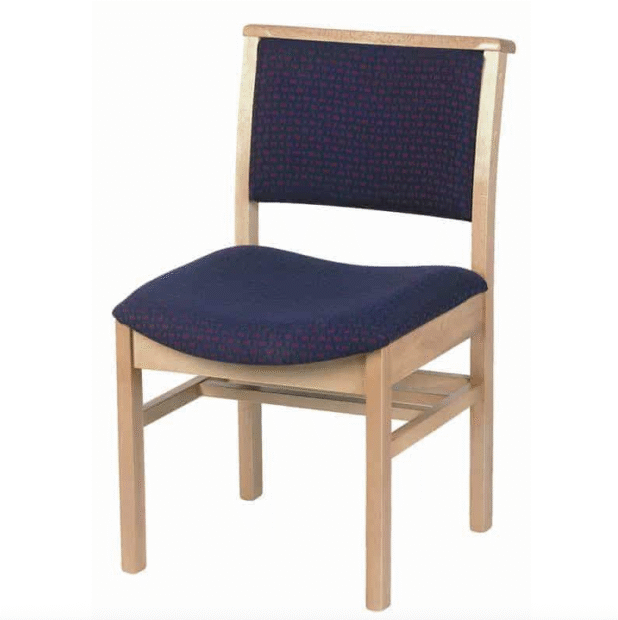
This contract-grade chair features a robust design, including mortise and tenon joints that are among the strongest, oldest and most durable joint designs in the world. Further, the Churchill Deluxe is upholstered in a fire-retardant fabric that will have been subjected to the Martindale Rub Test – a test that ensures the fabric will withstand robust use.
These are all design features that will be lacking on an ‘equivalent’ domestic chair.
Which is brings us back round to a point we mentioned earlier; contract furniture has a better total cost of ownership compared to domestic furniture. Take the chart below:
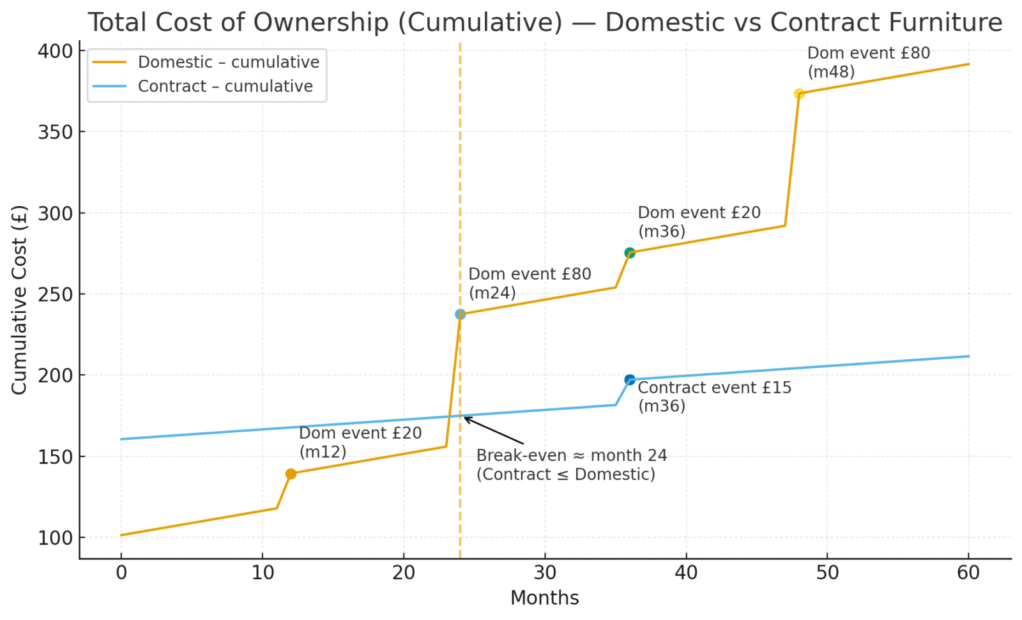
This chart shows the total lifetime cost of a piece of contract furniture versus domestic furniture. You can see that the initial cost of the contract furniture (the blue line) is higher than the domestic furniture (yellow line).
However, within 12 months (m12), the domestic furniture has experienced a failure (let’s say the upholstery has torn). This requires you to lay out £20 for repairs. Over this same time period, the contract furniture is still failure free.
Over time, you can see how the domestic furniture has repeated failures (at 2 years, 3 years, and 4 years) – the contract furniture has had a single failure event at 3 years.
In total, the contract furniture has a lower total cost of ownership.
This perhaps can be summed up with the old phrase, “quality is remembered long after the price is forgotten”.
Liability and insurance
Another very important reason you should purchase contract furniture over domestic is because of potential liability and insurance issues.
Should you use domestic furniture in your space and an incident occurs (e.g. a fire breaks out, someone is injured etc), then you could both be subject to enforcement action and have your insurance policy invalidated.
Those are both very negative outcomes!
Let’s have a look at two examples. The first of which involves fire safety. Imagine you run a small bar. Any upholstered furniture (e.g. chairs for your patrons), must be upholstered in a fabric that meets the Crib 5 standard.
Now, imagine that you decided to go down the ‘cheap’ route and just buy some chairs off the high street instead.
A fire breaks out and spreads due to the chairs not being up to the Crib 5 standard. Under the Regulatory Reform (Fire Safety) Order 2005 (FSO), you could be subject to:
- Enforcement/prohibition notices.
- Unlimited fines.
- Up to 2 years’ imprisonment.
Those chairs don’t seem so cheap when you consider the potential consequences listed above.
Now, let’s consider another scenario.
You run a small IT business and have an office for your six employees. You have a corner of the room where you have set up a kitchen, dining table and chairs. Instead of buying a proper contract-quality canteen table, you instead pick up some cheap four-legged chairs from a high-street retailer.
One of your employees sits on a chair, tips back on it, falls and hits their head on the floor – necessitating a visit to the local A&E department. Under health and safety law, you could now be subject to enforcement action. Indeed, you could also be subject to civil liability as you have failed to show ‘common duty of care’.
These are all scenarios that can be avoided if you choose contract furniture over domestic furniture.
Operational features
This is more of a practical concern, but in the majority of settings, contract furniture is simply easier to use from an operational perspective.
The key point to remember here is that people use furniture in public places differently from how they use furniture in domestic settings.
When was the last time you had to stack chairs at home? Indeed, when was the last time you had to transport a table to different rooms in your home? We’re willing to bet your answer is “rarely, if ever”.
Furniture in many public spaces (think community centres, cafés, conference centres, offices), is regularly moved, stacked and stored away.
It’s for that reason, contract furniture designers include useful features to facilitate this type of use. These features include:
- Stackability: allowing chairs to be stacked up to certain densities.
- Linking clips: so that chairs can be affixed in defined rows.
- Trolleys: enabling you to move stacks of chairs with ease.
- Floor-fixing: so that chairs/benches can be fixed in place (particularly useful in high-risk environments such as A&E waiting areas or custody suites).
- Glides/castors: facilitating the movement and stationary stability of chairs.
- Foldability: ensuring tables can be moved and stored more easily.
Domestic furniture rarely includes such features (because, why would it?!). As a result, if you buy domestic furniture for your space, you’ll find it’s generally less convenient to use.
Ergonomics
An especially important point if you’re responsible for a space where people are seated for multiple hours per day: ergonomics is a key factor in contract furniture design (and less of a concern in domestic).
Ergonomics is defined as the study of ‘the interactions between people and other elements of a system’. In the context of furniture, it refers to ‘items of furniture to which ergonomic principles have been applied’. Such items have natural curves and features that support the human body.
In other words, ergonomic furniture is designed to be used for long periods of time without causing harm or injury to the user.
Contract furniture is predominantly designed with ergonomic principles at the forefront of mind, with items like task chairs, meeting room chairs, and even stacking chairs regularly incorporating ergonomic principles and features.
By its very nature, domestic furniture doesn’t intrinsically incorporate ergonomics (as anyone who has worked from their kitchen table and chair can tell you!).
Again, we come back to the issue of liability. If, for example, you provide your employees with domestic chairs that result in injury after long periods of use, you will be liable under a whole raft of legislation.
Avoid that scenario by choosing contract furniture instead!
Guide: find out more about ergonomics and furniture in our guide, What Is Ergonomics & Ergonomic Furniture?
Sustainability
If you work for an organisation that takes its environmental obligations seriously (or, indeed, has environment targets to meet under an ESG strategy), then it’s imperative that you choose contract furniture.
Contract furniture manufacturers recognise this reality for many building managers, and have developed their products accordingly. The same can’t be said for domestic furniture.
Contract furniture that has been designed with sustainability in mind will:
- Be designed to provide maximum longevity, with no ‘planned obsolescence’.
- Be manufactured from materials that come from renewable sources (or recycled materials).
- Not use materials that contain – or are imbued with – polluting or harmful chemicals.
- Be designed to be easily recyclable once it reaches the end of its serviceable life.
Guide: for more tips on buying sustainable furniture, read our guide How to Buy Sustainable Furniture.
You will find that many contract furniture manufacturers design and build their products in-line with defined certifications and standards. This allows you to provide credentials should you need to verify the sustainability of your furniture.
Examples of sustainability credentials used within the contract furniture industry include:
- FSC: Forest Stewardship Council certification, which indicates that an item of furniture has been manufactured from sustainably-sourced wood.
- Greenguard: a set of certifications that prove that an item of furniture has limited chemical emissions.
- BIFMA: this standard ensures that furniture has been independently assessed by a third-party against strict quality standards.
- CarbonCare: a certification that allows furniture manufacturers to prove their carbon emissions and carbon footprint.
Guide: for more information about furniture sustainability standards, read our guide, A Guide to Sustainable Furniture Standards.
Hygiene and cleanability
An often overlooked point in the contract vs domestic furniture debate is hygiene and cleanability.
Public spaces are busy places. Whether you’re responsible for a waiting room, office, canteen, schoolroom or another other public area, you’ll know that these are intensively used spaces.
People come and go. They sit and stand, work at desks, eat at canteen tables, wait and read.
All the while, they’ll be leaving behind dirt, detritus, spills and crumbs and myriad other related things.
Which means that furniture in public spaces needs to A) be able to withstand spillages, stains and other abuse, and B) be able to be cleaned and withstand high cleaning cycles.
Contract furniture (in contrast to domestic furniture) is explicitly designed to meet these challenges. Designers create items of contract furniture with hygiene and cleanability forefront of mind (in a way that the designers of domestic furniture do not).
Hygiene and cleanability-focused features you’ll find on contract furniture include:
- Sealed edges and radii: tables will typically feature post-formed, high-pressure laminate or PU cast edges, preventing dirt from accumulating on edges.
- Minimal dirt traps: for example, many chairs feature ‘hygiene gaps’ (at the base of the seat back) to prevent the accumulation of dirt and detritus.
- Barrier layers: some healthcare-focused furniture feature sealed seams or moisture-barrier interliners to protect against spills/liquids etc.
Aside from the structural design of contract furniture, the materials used are also hygiene and cleanability-focused. For tables this can include the use of compact laminate table-tops, powder-coated metal frames, whilst for chairs, this can include the use of specialist anti-microbial fabrics and/or vinyls.
Many of these materials are designed and manufactured against stringent standards – to provide further reassurance. Examples of these standards include:
- EN 12720: Furniture. Assessment of surface resistance to cold liquids.
- EN 12721: Furniture. Assessment of surface resistance to wet heat.
- EN 12722: Furniture. Assessment of surface resistance to dry heat.
- EN 438: High-pressure decorative laminates (HPL).
As with the other points considered in this guide, contract furniture meets far higher standards and criteria compared to domestic furniture. If you want to enforce a stringent cleaning regime (such as in a GP surgery or hospital), purchasing contract furniture is a must.
Rosehill: the home of contract furniture online
If you want to purchase contract-quality furniture for your space, then your buying journey starts and ends with Rosehill.
With long-standing relationships with the UK and Europe’s leading contract manufacturers, Rosehill is able to secure discounts and deals that you won’t get anywhere else.
Speak to Rosehill about your contract furniture needs today
For more commercial and contract furniture buying guides, advice and information, read the Rosehill blog…
What Is Contract Furniture? | What Is FF&E? | When Do I Need to Order Contract Furniture?