


Lumbar support: it’s a phrase that many people have heard of, but few people truly understand. If you want to know everything there is to know about lumbar support, then read this detailed guide from the Rosehill team now…
What is lumbar support?
So, let’s begin things with a definition. What exactly is lumbar support? What does it mean? What does it refer to?
Let’s begin with the first part of the phrase; lumbar.
Lumbar refers to a certain segment of your back known as the ‘lumbar spine’.
The lumbar spine consists of five individual bones (a.k.a. vertebrae). These are the L1, L2, L3, L4, and L5 vertebrae. Together, these vertebrae form what is commonly called the ‘lower back’.
Note – the spine is traditionally divided into five ‘parts’. In addition to the lumbar spine, there are also the cervical spine (the top part of the spine in the neck), the thoracic spine (the part of the spine that supports the chest), the sacrum (a bone that connects the spine to your hips), and the coccyx (the tail bone).
Whilst all parts of the spine play important roles, the lumbar spine is especially important as it supports most of your body’s weight. In addition, it’s also the centre of your body’s balance, and it is also an anchoring point for numerous muscles and ligaments.
Because of all the roles the lumbar spine plays, it’s critical to your ability to comfortably walk, run, tilt, pivot, lift, and to move in general.
A distinctive feature of the lumbar spine is its shape. If you have a mirror handy, you’ll be able to spot it easily. The lumbar region is the part of your spine that gently curves inwards above your buttocks. Interestingly, this curve has its own name – the lodotic curve.
Thanks to this curve, your spine as a whole (looking at it side on) should have a gently curving ‘S’ shape.
It’s this shape and the curve of the lumbar spine that we’ll turn to next, which brings us to the second part of the phrase – support.
Put simply, the idea behind lumbar support is to maintain the natural lodotic curve of the lumbar spine.
It’s perhaps easier to explain with a real-world example.
If you spend a long period of time sitting at a desk working, it can be easy for your spine to slouch into a ‘C’ shape (think about being hunched over typing). This effectively reverses your lodotic curve, pushing your lumbar vertebrae into an unnatural position. This sort of position can place particular strain on the L4 and L5 vertebrae.
Maintaining and repeatedly sitting in this unnatural position can result in injury to your lumbar spine (a.k.a. lower back).
The idea, then, behind lumbar support is to help maintain what’s known as a ‘neutral sitting position’, where your lodotic curve – and the natural ‘S’ shape of your spine is maintained. This prevents undue stress on your back and development of injury.
Why is lumbar support important?
At this point you may be wondering if lumbar support is all that important?
Well, if you’ve ever experienced lower back pain, then you already know the answer!
More broadly though, lower back pain is a widespread problem. According to statistics from the NHS, more than 80 out of every 100 people in the UK will experience lower back pain at some point in their life.
Furthermore, the Office of National Statistics’ (ONS) latest figures from 2022 show that an estimated 185.6 million working days were lost to sickness or injury that year. Drill down into this data, and you’ll see that musculoskeletal problems were the third leading cause of absence from work in 2022.
In short, for the sake of both your employees’ health and the productivity of your business, it pays to take lumbar support and musculoskeletal health seriously.
What are the benefits of lumbar support chairs?
As we alluded to above, chairs with lumbar support can have a number of benefits – most notably in preventing workers from developing lower back pain from poor posture.
But, as an extension of this core benefit, lumbar support chairs can bring a number of other benefits to your organisation. These include:
- Reduced back pain – for those who already suffer from lower back pain, a lumbar support chair can greatly alleviate their suffering.
- Improved productivity – lumbar support chairs promote proper posture, and are generally more comfortable to use. As a result, you’ll find that they contribute to the productivity of your employees.
- Encourage office use – not everyone can afford to buy an ergonomic chair with lumbar support for their home. For those workers who are still working from home on an uncomfortable kitchen chair, providing them with a chair with lumbar support is a great incentive for them to come into the office more often.
As you can see, there are more benefits to buying chairs with lumbar support than many people first realise!
How does lumbar support work?
As you’ve probably gathered, lumbar support in practice is applied to chairs of various kinds (but most commonly to office and operator chairs).
In practice, lumbar support can take a number of different forms which we have detailed below:
Fixed/integrated lumbar support
An increasing number of chairs feature lumbar support that is built in directly to the design of the chair.
This typically takes the form of the back rest of the chair having a distinct curve towards the bottom of the back rest (e.g. in-line with the lumbar region). The image below shows an example of an office chair with fixed lumbar support:
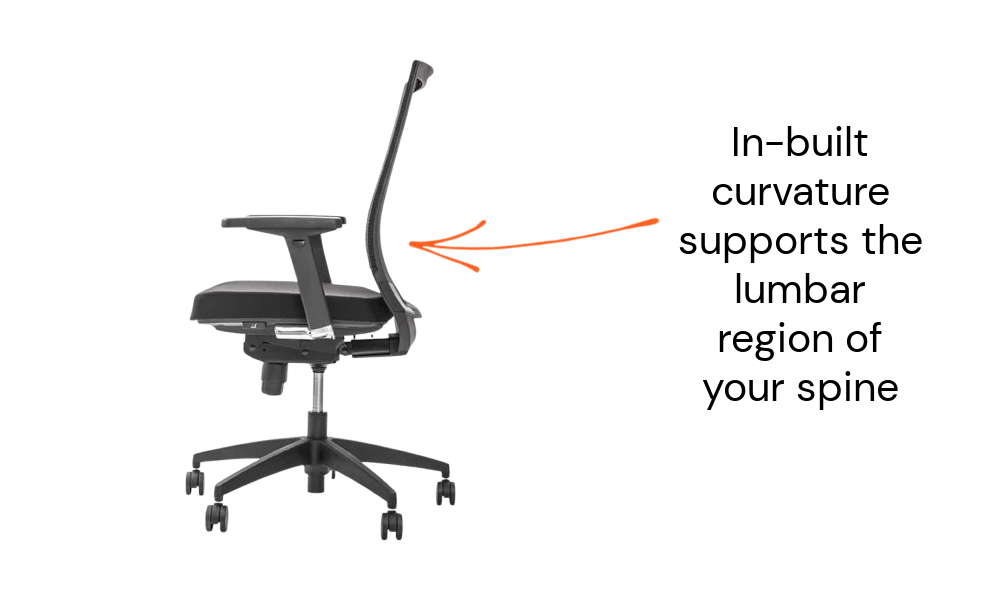
Note – not all chairs explicitly state they feature ‘lumbar support’. Some manufacturers simply refer to chairs with lumbar support as ‘ergonomic chairs’. If in doubt, check the back rest of your chosen chair. If it has a distinctly curved lower portion, then it offers lumbar support.
Chairs with fixed lumbar support have become incredibly popular as employers have sought to do more to prevent employees from developing work-related back injuries.
As such, it’s now possible to buy even budget office chairs with fixed, built-in lumbar support.
However, like other types of contract furniture, it’s possible to buy premium office chairs that offer a greater degree of lumbar support. Which brings us onto our next point…
Adjustable lumbar support
Move up the price scale, and you’ll come to chairs which offer adjustable lumbar support.
As the name suggests, this is a type of chair whereby the lumbar support can be actively adjusted.
This type of adaptive lumbar support is particularly useful if the chairs you are buying are going to be used by multiple different people e.g. in a hot desk-based office. We’re all a different size, height, weight and shape – so it makes sense to choose chairs that allow the lumbar support to be easily adjusted.
You’ll find that on most chairs with adjustable lumbar support, the lumbar ‘section’ can be adjusted in terms of height, as well as how far horizontally it protrudes into your lower back (thus fitting people whose lodotic curves are more or less curved).
If you’re looking for a chair which features adjustable lumbar support, try the Napier Mesh Back Operator Chair. As you can see from the image below, this is a chair that has a high-degree of adjustability, as well as a gas lift, comfortable mesh back and a five-star swivel base with castor wheels.
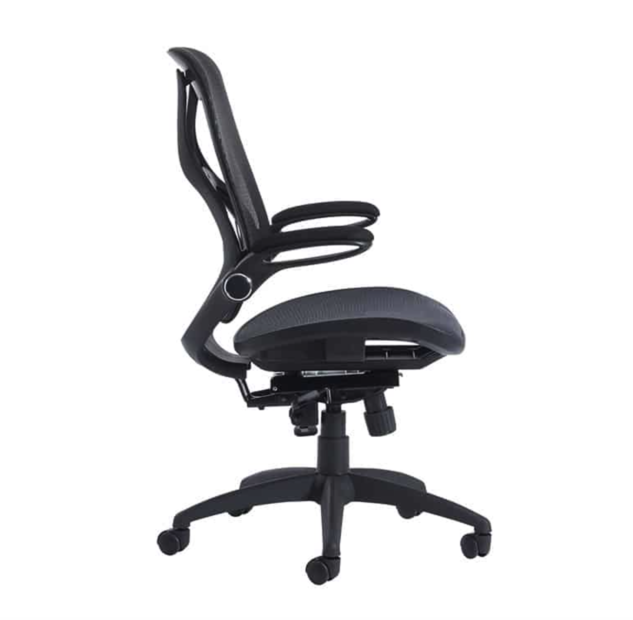
Shop Now – Napier Mesh Back Operator Chair
Tip – it’s not always clear if a chair has adjustable lumbar support. If you are looking at a chair on the Rosehill website and want to know if it has adjustable lumbar support, just contact our friendly, expert team. They’ll be happy to help!
External lumbar support
The third main type of lumbar support that you’ll encounter is ‘external lumbar support’.
Sounds strange, doesn’t it?! But, it’s not really.
External lumbar support refers to a device you add to a chair. Think of it as a kind of curved cushion. It will generally have an elasticated fabric brand which is used to keep the cushion fixed to the bottom of the chair’s back pad. The cushion itself is curved, protruding out into your back – and therefore maintaining your lodotic curve.
External lumbar support is the perfect option if you have a load of office chairs without lumbar support. Instead of having to invest in a whole new suite of chairs, you can add lumbar support to your existing chairs by adding lumbar support cushions. Easy!
Lumbar support cushions (which are sometimes also called lumbar rolls) are available in a wide range of different sizes and shapes – so, it’s easy to select one that perfectly matches the curvature and shape of your back.
Where should lumbar support be?
This may seem like a question with an obvious answer – but, where should lumbar support be?
The answer is that lumbar support should be positioned at the base of a chair’s backrest. The lumbar support – be it integrated into the back rest, or an external lumbar roll – should protrude into your lower back, just above your belt line.
However, given that people come in different shapes and sizes, it’s important to check your chosen chair actually provides the lumbar support in the correct part of your back. It’s for this reason that some people – especially those who have a history of lower back pain – decide to invest in a chair with adjustable lumbar support, so they can really fine tune the level of support.
Note – women typically have a more pronounced lodotic curve, and thus will need more pronounced lumbar support on their chairs.
How to sit with lumbar support
When you first sit on a chair that features lumbar support, it may feel slightly strange (especially compared to a traditional chair with a ‘flat’ back rest).
However, once you’re used to it, sitting in a chair with lumbar support isn’t really that different. If you do want to fully benefit from the lumbar support on a chair, keep these tips in mind:
- Always ensure you sit with your back fully against the back rest. If you perch on the edge of the seat, your back won’t benefit from the lumbar support. You have to properly sit in the chair, not merely on it.
- Try to avoid slouching if you are engaged in tasks like typing. Maintain an upright position in order to fully benefit from the lumbar support.
- Ensure your chair is properly set up so that you can maintain the correct posture. You want to ensure that your chair is correctly set up for your popliteal height, sitting height and other important factors. For more information on this, read our guide to ergonomics.
- Remember to stand up and walk around every so often. Even in a chair with lumbar support, your back will need to change position occasionally.
If you remember to follow these tips, you’ll get the most benefit out of your chair with lumbar support.
How to adjust your lumbar support
Depending on the type of chair you purchase, there will be different ways to adjust the lumbar support. Let’s have a look at how each type can be adjusted:
- Chairs with built-in lumbar support – for this type of chair (where the lumbar support is integrated into the seat back), you only have a limited range of adjustment. Adjustment is typically limited to the back rest height, and thus where about the lumbar support part of the seat back sits against your back.
- Chairs with adjustable lumbar support – adjusting the lumbar support on this type of chair is usually as simple as turning a knob located under the seat pan. This moves the lumbar roll forward or backward as required. Some chairs also include a feature that allows you to adjust the firmness of the support, allowing you to dial up or down how hard or soft it is.
- External lumbar support – if you are adding a lumbar roll to a chair, you simply need to add it to the seat back and adjust it until it is comfortably supporting your lumbar region.
Note – the above points are generalisations. Every chair is different and various manufacturers offer different levels of adjustability. If you have questions about the way in which a particular chair can be adjusted, contact us.
To summarise this section, you’ll know when your lumbar support is correctly adjusted as it will ‘fill’ the gap between your lower back and the chair’s backrest. It should, however, fill it in a way which is comfortable and not exerting too much pressure on your lumbar spine.
Can you add lumbar support to an ergonomic chair?
Yes! There is often a great deal of confusion between the terms ‘ergonomic chair’ and ‘lumbar support chair’.
As there is no set industry definition of either term, you can often see chairs which are described as ergonomic – but which do not have lumbar support. Likewise, it’s possible to buy chairs with lumbar support that are not particularly ergonomic elsewhere in their design.
If you have purchased an ergonomic chair – but, it’s missing that all-important lumbar support at the bottom of the back rest, then all you need to do is buy an external lumbar roll and add it in. Easy!
Who needs lumbar support
So far, so good. But, the question often arises – particularly amongst cash-strapped building or office managers – who needs lumbar support?
Don’t fall for the urban myth that chairs with lumbar support are only for those individuals with chronic lower back pain.
If you want to create and maintain a healthy working environment, everyone should have a chair with lumbar support.
By providing everyone in your business with a lumbar support chair, you can potentially prevent lower back pain from developing in the first place.
Sure, buying a suite of new chairs has an upfront capital cost. But, the cost to your business through loss of productivity as a result of musculoskeletal injury could potentially be much higher.
Looking for a chair with lumbar support?
Then you’re in the right place! Here at Rosehill you’ll find a massive range of lumbar support chairs. Spanning everything from office and operator chairs to armchairs, you’ll find plenty of seating options to keep your back happy at Rosehill.
If you’re not sure what options are best for you, then please contact our friendly team who will be happy to help!
Shop chairs with lumbar support at Rosehill now
For more commercial and contract furniture buying guides, information and advice, read the Rosehill blog…
Buying a Standing Desk? Everything You Need to Know | Office Chair Buying Guide | Conference & Meeting Room Table Buying Guide